Case Study: What It Actually Takes to Remove a Year-Old Urine and Sweat Stain From a Mattress
Most calls we get are about a spill from last week. This one was different. The mattress was five years old and had never been cleaned once — not a single pass, ever. Some of the staining on it was over a year old. Here's what the assessment showed, what the removal actually involved, and what the mattress looked like when we were done. No filter on the result.
What we found on first look
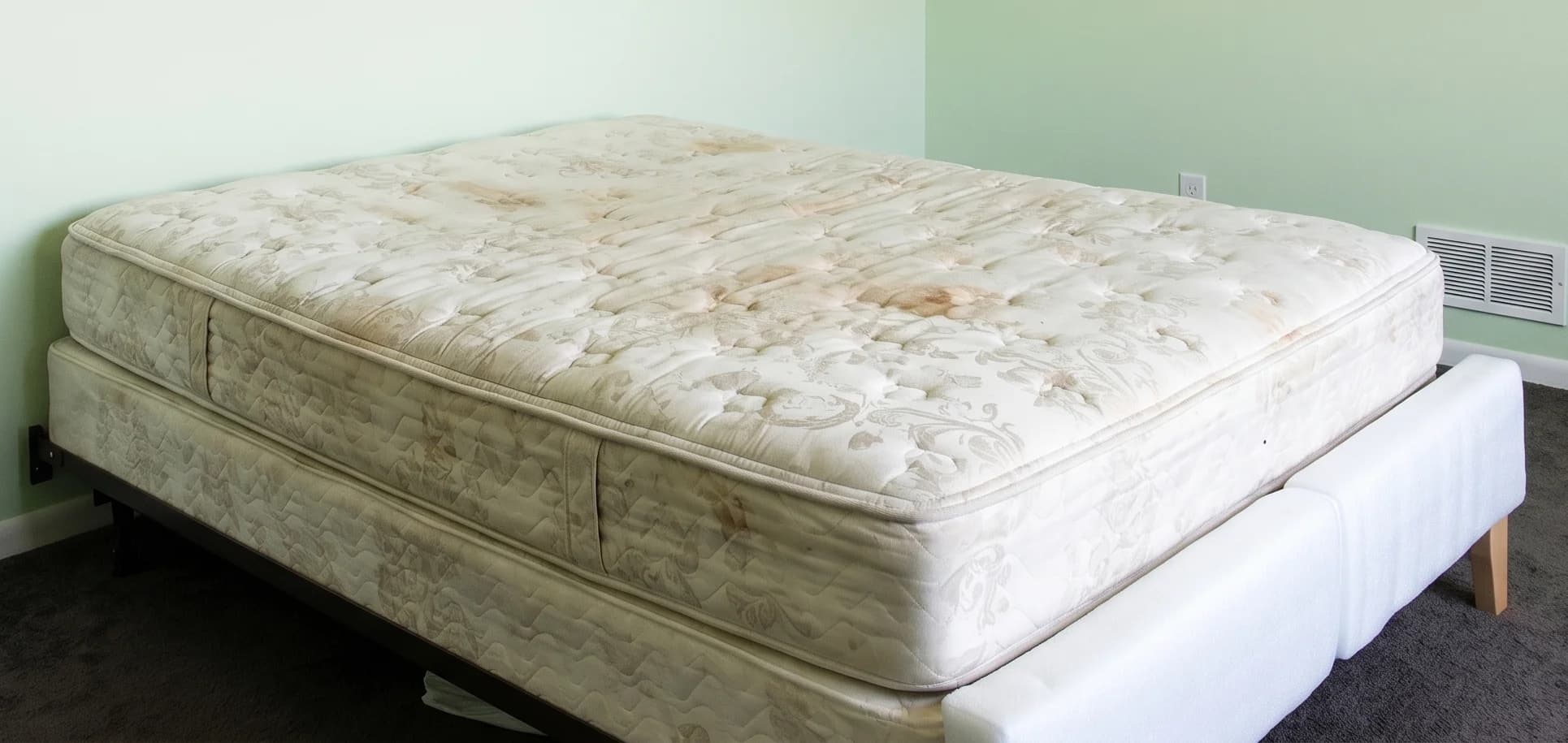
Before touching anything, the picture was: several stains of clearly different ages sitting on the same surface. A few marks were pale and recent-looking. Others had gone a deep yellow-brown — the color shift that tells you a stain has been sitting for months, not days. The largest and most concentrated stain sat roughly in the center of the mattress. Lighter, more diffuse marks ran along one side, which is typical of sweat migrating and drying over repeated use rather than a single spill.
The fact that the mattress had never been cleaned mattered as much as the stains themselves. Without any prior treatment, there was no protective layer left to work with — everything had gone straight into the fabric.
Why a one-year-old stain isn't just a bigger version of a fresh one
This is the part most people don't expect: a year-old stain doesn't just need more scrubbing. It needs a different approach entirely.
Fresh urine or sweat sits mostly on the surface of the fibers. Given a year, two things happen. The proteins and salts in it oxidize, which is exactly what produces that yellow-brown discoloration — it's a chemical change, not just "dirt sitting there longer." And with repeated heat and moisture cycles from normal sleeping use, the residue works its way deeper into the fabric and the padding underneath it. At that point you're not lifting a stain off a surface anymore; you're drawing it back out of layers it's had a year to settle into.
That's why patience matters more than product strength here. Going in aggressively on an old, oxidized stain can set it further or damage the fabric before it ever lifts.
The process: more steps than a typical mattress
A standard mattress cleaning is usually one thorough pass with a pre-treatment step for any visible marks. This one wasn't that. It took several rounds of treatment, and more than one type of stain approach was tried — because a single method wasn't enough to work through both the fresh and the fully oxidized staining on the same surface. Realistically, this job took noticeably longer than a typical mattress, and that's worth saying plainly rather than pretending every job takes the same amount of time. A mattress that's never been cleaned, with a year of build-up, is a different job than a mattress that gets touched up every six months.
The stain that took the longest
The center stain was the hardest part of this job. It wasn't the largest visually, but it was the most stubborn — the combination of its age and how deep it had set meant it didn't respond to one or two passes the way the lighter marks did. It came down to slow, repeated, patient work rather than any single step doing the job. That's usually how the worst stain on a mattress goes: not a dramatic single fix, just steady work until it actually lifts.
The honest result
Here's the part we'd rather be straight about than oversell: this mattress didn't come out looking brand new, and on staining this old, that almost never happens. Anyone who tells you a year-old, never-cleaned mattress will look factory-fresh afterward isn't being honest with you.
What did happen: the surface came up dramatically lighter across every stained area, the deep saturation was gone, and what's left is faint, flat discoloration rather than the raised, visible staining you can see in the before photo. That's the realistic ceiling for organic staining this age — not invisible, but no longer active, no longer smelling, and no longer the first thing you notice about the mattress.
Signs you're dealing with an aged stain, not a fresh one
- The color has shifted toward yellow, amber, or brown rather than the original color of whatever caused it
- The area feels slightly stiff or crusted rather than soft to the touch
- The mattress has never been professionally cleaned
- More than one type of mark is present — urine, sweat, and sometimes something unidentified layered together
- Home stain removers have already been tried without lasting results
If more than one of these applies, you're likely looking at the same kind of job described here, not a quick spot-treatment.
If your mattress has stains that have been sitting for a while, or you're not sure what you're dealing with, we can take a look and tell you honestly what's realistic before any work starts. Professional mattress cleaning is worth considering when stains have gone past what home products can handle.
Frequently asked questions
Can a year-old urine stain be fully removed?
Often significantly lightened, sometimes to the point of barely noticeable, but full invisibility isn't a realistic promise on staining this old. Odor removal tends to have a better outcome than full color removal.
Is it worth professionally cleaning an old mattress stain instead of replacing the mattress?
For a mattress that's otherwise in good shape, cleaning is almost always cheaper than replacement, even when it takes multiple passes like this case did. Replacement makes more sense if the mattress itself is past its useful life for reasons unrelated to the stain.
Why does this cost more than a standard mattress cleaning?
Because the actual work is more — more passes, more time, sometimes more than one treatment approach on the same mattress. A mattress that's never been cleaned isn't priced the same as maintenance cleaning, for the same reason a first deep clean of anything usually takes longer than the second one.
Need help with a stain on your furniture?
Send us photos for an assessment and estimate.