Pet Hair on Your Sofa: What Vacuuming Can and Can't Remove
Pet hair on a sofa is one of those small everyday frustrations that keeps coming back. You vacuum the cushions, the seat looks better for a day or two, and then the hair returns — or, more puzzling, some of it did not move at all.
The reason is simple: not every strand of pet hair behaves the same way on upholstery. Some sits loosely on the surface and vacuums up easily. Some becomes caught in the fabric itself, where a vacuum has far less reach. This guide explains the difference, what careful home removal can and cannot do, and when professional help is worth considering.
Loose hair and embedded hair are not the same
A portion of the hair on any upholstered piece is simply lying on the surface. Loose hair like this is what a vacuum is built for: with the right attachment, suction can remove loose surface hair.
The rest is a different story. Hair can become caught between fibres, in textured weaves, along seams, in the crevices between cushions, in creases, and in the pile of soft or open fabrics. Fine, short hairs slip into the gaps of a weave. Longer hairs wrap themselves around individual fibres. With everyday use — sitting, shifting, a pet settling into its favourite spot — hair is pressed deeper into the surface over time.
Why vacuuming sometimes leaves hair behind
A vacuum lifts what is loose on or near the surface. It does not untangle hair that is already wrapped or woven into the fabric, because suction alone cannot grip individual strands that are held by the fibres around them.
Static electricity can also make hair cling to some fabrics. Fibre type, friction and dry conditions can affect how much static charge builds up, which is why hair sometimes seems to hold on with more force than its weight would suggest.
How a vacuum performs on any given sofa also depends on how well the attachment makes contact with the upholstery, the direction of the fibres or pile, the length and stiffness of the hair, and how deeply it has worked into the surface. Vacuum power is only part of the equation.
Why the fabric matters
The same mechanical action that is harmless on one sofa can be wrong on another. A tight, smooth, durable weave tolerates brushing and friction that a delicate, loosely woven, brushed, or piled fabric does not. Textured surfaces also hold hair differently: an open or looped texture gives hair more places to anchor.
There is no single rule that applies to every textile. The fabric's care label and the manufacturer's guidance are the most dependable reference, and any fabric you are not sure about deserves the gentlest possible treatment.
Where pet hair tends to collect
Hair concentrates where fabric folds, meets, or changes direction:
- along seams and piping;
- around cushion edges and in the crevices between cushions;
- in the corners of armrests and backrests;
- in the creases that form where people usually sit.
These are also the places where hair is pressed deepest by everyday use, which is why they are the last places a quick pass over the flat surfaces will clean.
What careful vacuuming can reasonably do
Used with patience, a vacuum can remove loose surface hair:
- Work slowly with an upholstery attachment — a soft brush attachment where the fabric allows it, and low suction if the care label suggests it.
- Use a crevice tool along seams, cushion edges, and corners, where the full-size attachment cannot reach.
- Make more than one pass, and vary the direction, so hair lying along the fibres is approached from different angles.
What remains after this is usually the embedded portion — the hair that mechanical vacuuming alone is not designed to remove.
Safe things to try beyond vacuuming
If careful vacuuming leaves hair behind, gentle mechanical tools may help on suitable fabrics. Follow the furniture and fabric care instructions first, test any tool in a small inconspicuous area, and stop if the texture, pile, colour, or surface appearance changes:
- A lint roller is gentle and may suit many durable upholstery fabrics.
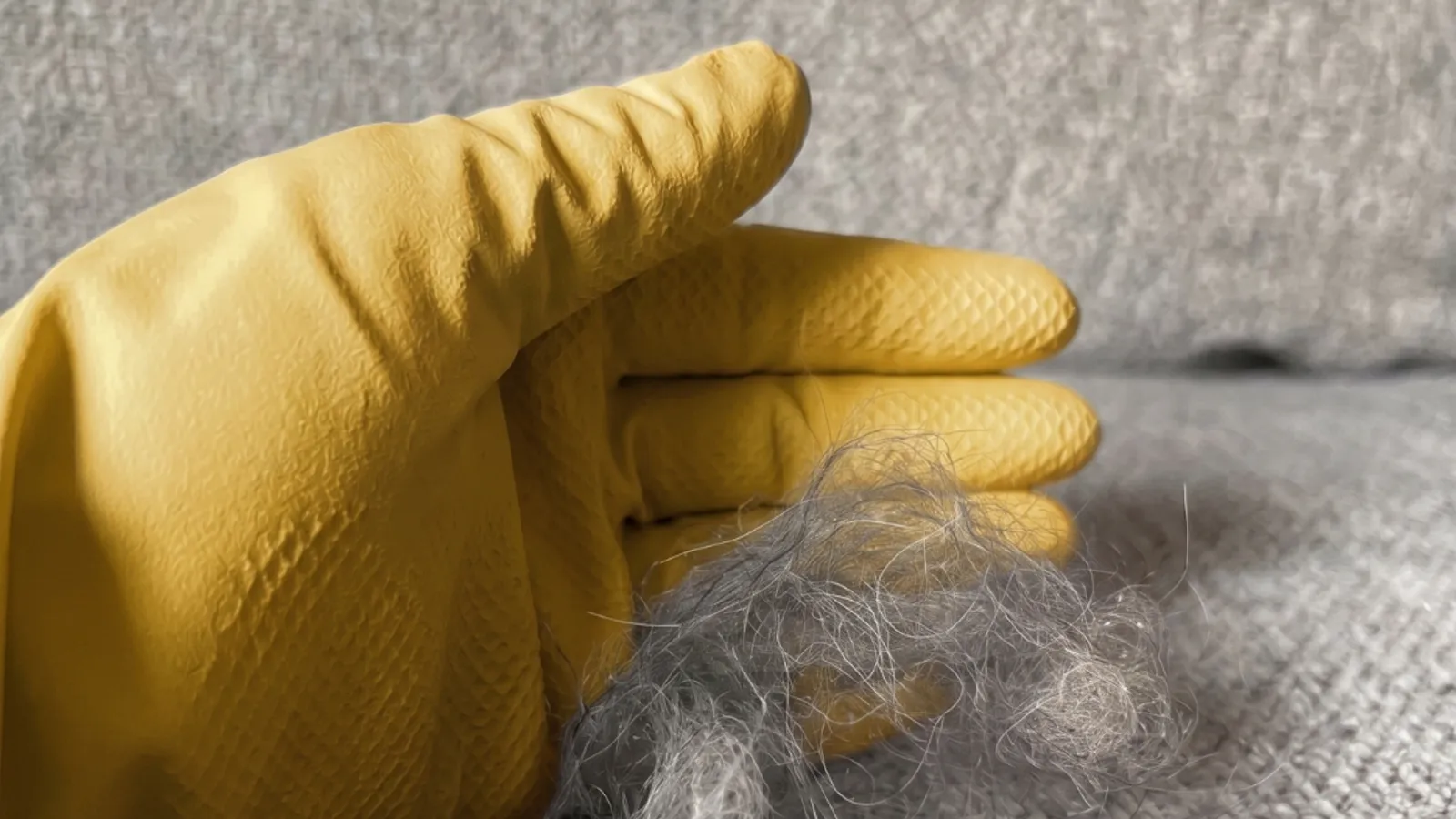
- A damp — not wet — rubber glove or a rubber squeegee can gather hair into clumps on many durable upholstery fabrics. The friction does the work, which is also why the method is not suitable everywhere.
- A soft-bristled upholstery brush can loosen hair on fabrics that tolerate light brushing.
Treat these as mechanical hair-removal steps that come before wet upholstery cleaning. Visible loose hair is better addressed before any wet cleaning, not by it — this is the stage where hair actually comes away.
What to avoid
Some instinctive methods make embedded hair harder to deal with, or damage the fabric:
- hard brushes, scrapers, or improvised sharp tools;
- aggressive scrubbing, which presses hair deeper and can roughen the surface fibres;
- cleaning products or chemical treatments used only to remove dry hair — they are unnecessary, and residues can make a later professional cleaning less predictable;
- any mechanical method applied to a delicate, loosely woven, brushed, or piled fabric without first testing in an inconspicuous area.
Pet hair is not the same as urine, odour, or stains
Visible pet hair, embedded hair, stains, urine contamination, odours, and dander are different problems, and removing one does not remove the others. A sofa that looks free of hair can still carry marks, odours, or contamination from accidents, and those need their own assessment and treatment.
Dander is a separate matter again. It is not visible hair: it is made up of microscopic skin flakes that behave differently from hair fibres and can remain long after the visible hair is gone. This guide makes no claims about allergy relief — that is a question for a medical professional.
If your sofa has pet odours or marks along with the hair, treat them as a separate question. Pet urine in particular follows different rules from hair removal.
When professional cleaning is worth considering
A professional assessment is reasonable when:
- hair remains across much of the seating area after careful home attempts;
- the fabric is delicate, piled, or textured, and you would rather not risk it;
- the hair is mixed with general soiling or body oils, or the piece also has stains or odours that need attention.
Professional pet-hair removal can involve extra mechanical work and time, before or during the cleaning itself. TissuCare assesses the piece first and explains what is realistic before any work begins. Clear photographs of the seating area and close-ups of the worst spots help that assessment happen before anyone arrives.
Realistic expectations
A professional service may remove additional visible pet hair. It cannot promise that every last strand will come out: hair worked deep into the weave, or wound tightly around fibres, may remain. Results vary with the fabric, its construction, the hair itself, and the condition of the piece.
Professional upholstery cleaning commonly includes dry soil and particulate removal before any wet cleaning agents are applied, where appropriate. This work may also involve dedicated mechanical hair-removal and additional time — a different process from routine household vacuuming.
If visible pet hair remains after careful vacuuming and home removal, professional sofa cleaning may be the next step.
Frequently asked questions
Why does vacuuming leave pet hair behind on my sofa?
A vacuum removes what is loose on or near the surface. Hair that has worked into the weave, along seams, or between cushions is not always loose enough to be lifted by suction alone. Fabric texture, static electricity, hair length, and how deeply the hair has worked into the surface all play a part, which is why the same vacuum can behave differently on two different sofas.
Is a rubber glove or lint roller safe on upholstery?
Lint rollers, a damp rubber glove, and rubber squeegees may suit many durable upholstery fabrics, but they are not appropriate everywhere: delicate, loosely woven, brushed, or piled fabrics can react to friction. Follow the furniture and fabric care instructions, test any mechanical tool in a small inconspicuous area first, and stop if the texture, pile, colour, or surface appearance changes.
Will professional cleaning remove pet hair completely?
Professional upholstery cleaning commonly includes dry soil removal before wet cleaning agents are applied, where appropriate, and a service that includes pet-hair work may remove additional visible hair before and during cleaning. Complete removal is not promised on every fabric: strands worked deep into the weave or wound around fibres may remain, and results vary with the fabric, its construction, the hair itself, and the condition of the piece.
Need help with a stain on your furniture?
Send us photos for an assessment and estimate.